Welding Cobot vs Industrial Robot for Steel Fabrication
Welding cobots have changed who can automate. A small shop can now teach a robot by guiding the arm, without a programmer or a large cell. That raises a fair question for steel fabricators: can a welding cobot handle structural work, or do heavy parts still require a conventional robotic welding arm on a rail?
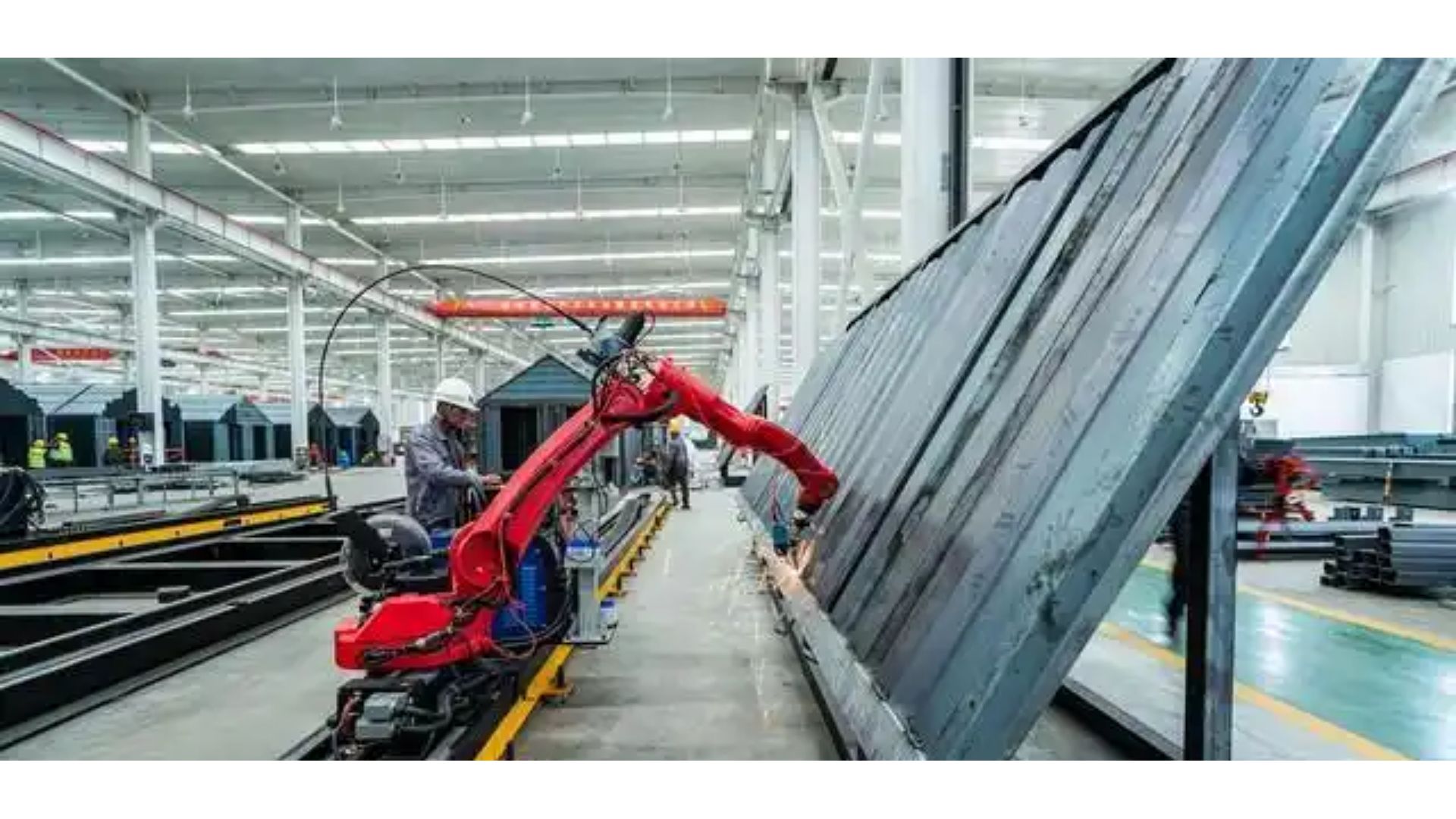
!Industrial robotic welding arm on a travel rail next to long steel members in a fabrication workshop
An industrial welding robot arm on a travel rail with bulk wire supply and gas rack, working long steel members.
Both have a place. The right one depends on your parts and your production.
What a Welding Cobot Does Well
- Fast to deploy and teach. Hand guiding and simplified software let welders program simple paths without robotics training.
- Small footprint. Many cobot welding stations are compact and can be moved between locations.
- Good for variety. Short runs, frequent changeovers and a mix of small and medium parts suit its flexibility.
- Lower barrier to entry. The learning curve is gentler for teams that have never run a robot.
Where Heavy Steel Fabrication Stretches a Cobot
These are not absolute limits. Models and systems differ, so verify each point against your own requirements.
Reach and travel. Long beams and large panels need a lot of reach or an external axis. Check whether the cobot can be mounted on a rail or gantry, and how well the travel axis is supported by the controller.
Duty cycle and heavy welding. Thick plates need high current and multiple passes over long stretches. Confirm that the complete welding package, including power source, torch and cooling, is built for sustained load, and how the robot behaves at the speeds the weld requires.
Sensing for variable parts. Structural steel has gaps and tolerances that call for laser tracking and multi-pass adaptation. Ask which sensors integrate natively and how they are calibrated.
Safety. Collaborative describes the robot's design, not the welding process. Arc radiation, spatter, hot metal and fumes remain, so the risk assessment usually leads to guarding or screens regardless of the arm type.
Throughput. Collaborative operation commonly runs at limited speeds when people share the space. When production targets are high, the full speed of a guarded industrial robot matters.
Where an Industrial Robotic Welding Arm on a Rail Fits
An industrial welding robot arm with a travel rail, bulk wire drums and laser sensing, similar to the setup shown, is built for continuous work on large parts:
- Long reach through a rail or gantry.
- High duty cycles with large wire supplies and robust torches.
- Advanced sensing and multi-pass programming for demanding joints.
- Two-station layouts that keep the robot welding while operators load the next part.
The trade-offs are a larger footprint, guarding, higher setup effort and programming skills (or offline software) the team must build.
Decision Guide
| Question | Leans toward a welding cobot | Leans toward an industrial robotic welding arm |
|---|---|---|
| Part size | Small to medium | Large, long or heavy |
| Weld length per part | Short and medium | Long and continuous |
| Material thickness | Thin to moderate | Thick, multi-pass |
| Production | High-mix, low-volume | Repeating families, higher volume |
| Programming skills | Welders with limited robotics experience | Dedicated programmers or offline software |
| Space | Tight, flexible | Dedicated area |
| Changeovers | Frequent | Planned, with fixtures |
Treat the table as a starting point. Most shops land in the middle, with some part families suiting each approach.
A Practical Way to Decide
- Pick three representative parts: one easy, one typical, one difficult.
- Define the weld requirements: joint type, thickness, position, length and inspection level.
- Test on real parts with each candidate, including worst-case fit-up.
- Compare total cost, not robot price. Include fixtures, sensors, guarding, training and the cost of rework.
- Consider a hybrid. A cobot station for small and varied parts plus a rail-mounted cell for large repeat work is a sensible combination for many fabricators.
Bottom Line
A welding cobot is excellent for flexible, low-barrier automation. Heavy structural steel often pushes toward an industrial robotic welding arm with travel and sensing, but the right answer comes from your parts, not from a label. Test before you buy. Send us sample drawings and your weekly volume and we will help you compare the options.
Comments (0)
No comments yet.
Sign in to join the discussion.