Understanding Laser Welding Robots in Automotive Manufacturing
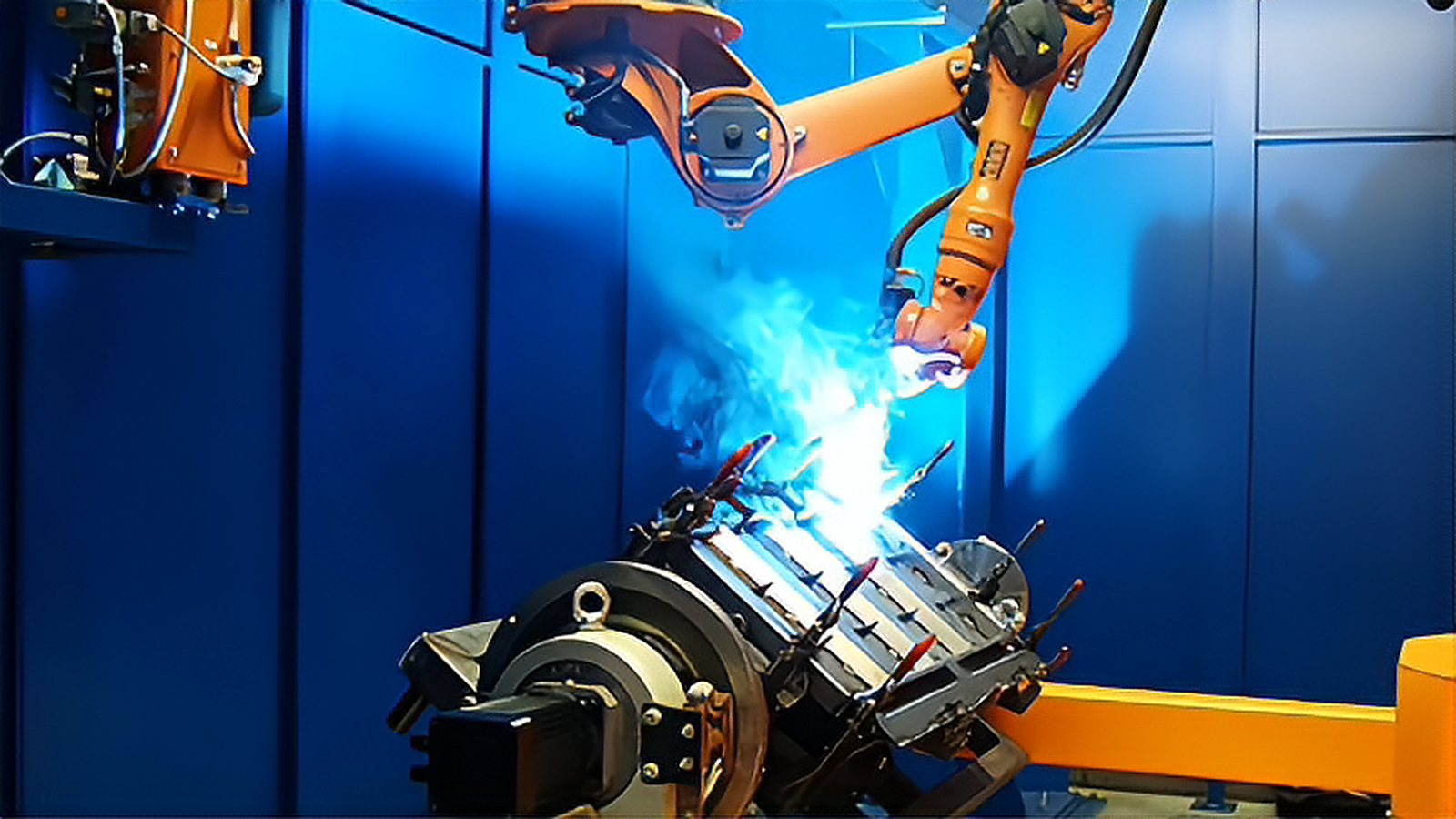
Automotive laser welding is not one process. Body shops combine remote laser welding with scanner optics, laser brazing for visible joints, tailored blank edge welding and aluminum structures, and each case carries its own tooling, clamping and control requirements. This article separates those cases and explains where the difficulty sits and how production teams address it.
Why remote laser welding suits body assembly
In remote laser welding a robot carries a scanner head on a smooth path about 0.5 m above the workpiece. The galvo mirrors redirect the focus between weld seams in milliseconds, and within the working envelope of programmable focusing optics the focus is repositioned in roughly 30 ms. Typical laser power is 4 to 6 kW, beam parameter product runs 4 to 8 mm mrad, and the focused spot is about 0.6 mm. The beam parameter product describes how tightly the beam can be focused and how long a working distance the scanner can hold while keeping that spot small, which is why the scanner can sit far above the part instead of touching it. The full trade off between galvo scanners versus gantry motion shapes the reach and speed of the cell.
The control architecture is what separates a working remote cell from a prototype. Robot and scanner form one kinematic chain: the robot positions the scanner over a zone while the scanner aims and defocuses the beam inside that zone. The controller must keep the two in axis synchronization, not merely time synchronization, because a change in robot speed alters how the seam forms. If the robot slows through a direction change, the travel of the focal point across the joint changes with it, and the resulting seam geometry shifts even though the laser program itself did not change. That is why seam tracking and vision are specified alongside the motion system, and why the scanner is normally programmed to a path defined in the part frame rather than the tool frame.
Most of the cycle time benefit comes from cutting index time rather than raising welding speed. Scanner focus moves between seams in milliseconds while a mechanical robot repositions far more slowly. In one published case, replacing conventional spot welding guns with laser optical heads allowed 16 robots to be arranged within 64 m², because each laser head reaches many more joints than a gun without moving the arm. Reading laser welding parameters alongside a layout study helps justify the cell before tooling is cut.
Typical remote laser welding applications cover seats, including recliner, frame, track and panel parts, plus body in white items such as trunk lid, rear structure, doors, side panels and pillars, and interior parts such as instrument panel crossmembers and rear shelves. An Audi A8 aluminum example used a 4 kW direct diode laser to complete nine welds on an aluminum suspension component in about 12 seconds, roughly half the time of conventional contact laser welding, with a claimed energy reduction of about 25 percent and no filler material.
Laser brazing for roof and tailgate joints
Laser brazing is the most visible automotive laser joint. Roof to side panel is the most common application: usually galvanized steel in a two layer lap, locally three layers, with a seam length of about 2.5 to 3 m. Brazing differs from fusion welding because the filler is melted while the base metal is only heated, so the joint forms without melting the steel itself.
The filler is a copper silicon alloy such as CuSi3 or CuSi3Mn1 covered by ISO 24373; it melts below steel, limits thermal distortion and is intended for galvanized steel body brazing. The lower melting point matters on thin, visible panels because less heat enters the outer skin, which reduces distortion and rework on a surface the customer will inspect directly.
One industrial case reported a roof seam of 3100 mm brazed with filler and a separate segmented seam of 3580 mm without filler, a whole station welding time of 36 s, a welding speed near 67 mm/s and 4 kW of power with no shielding gas. Audi has stated that laser joining seams on the A8 body total about 20 m. Where the seam is thin and the gap is tight, wobble welding can be used to improve wetting and stability.
Tailored blanks and edge fitup
Tailored blank welding began with a two piece Audi floor. Its value is joining different thicknesses and grades, improving material utilization and being highly automatable. Gap control is the whole game because the standard case is a through thickness butt weld with no filler. The rolling operation that brings the two edges together is what makes a gap below 0.1 mm repeatable in production; without it, coil thickness variation and edge quality alone would leave gaps the beam cannot bridge.
Above 0.1 mm, beam weaving or a dual spot can bridge the gap but reduces the maximum welding speed, so the choice between edge quality and weld speed is a real trade rather than a free fix. Typical sheet steel thickness is 0.7 to 2 mm and chassis parts run 2 to 4 mm. Published fitup guidance for laser welding gives butt joint gaps of 3 to 10 percent of the thinnest sheet thickness, mismatch of 5 to 12 percent, and lap joint gaps of 5 to 10 percent of the upper sheet thickness.
Galvanized steel and trapped zinc vapor
Galvanized steel is the persistent problem, and the mechanism is a race between melting and venting. Zinc vaporizes near 906 degrees Celsius while steel melts near 1538 degrees Celsius, so the coating becomes a vapor before the steel even liquefies. When two sheets are clamped tightly together the vapor has nowhere to go and is trapped at the lap interface, producing porosity, blowholes and spatter. The failure is not a machine fault but a fixture and coating interaction, which is one reason spatter control work on coated stock focuses on clamping rather than laser settings alone.
Three countermeasures are used. The first creates a vent path: roller clamping systems build a controlled gap at the interface, or stamped parts carry pre-formed dimples of fixed depth. The second sets a small gap of 0.1 to 0.2 mm for galvanized advanced high strength steel laps so zinc is not trapped by the melt pool; too large a gap produces underfill on the top surface. The third uses a dual beam in which the first beam heats or vaporizes the zinc layer and the second performs the weld, enabling welding without a gap at all.
Aluminum bodies and their specific demands
Aluminum brings high reflectivity, high thermal conductivity and low viscosity in the liquid state. High reflectivity complicates delivery because a large share of the beam can be reflected back toward the optics until a keyhole forms and absorption rises. Low viscosity means the melt is easy to displace, and high thermal conductivity pulls heat away from the joint faster than in steel, so power density above a threshold is required before keyhole welding stays stable. One referenced case welded 1.6 mm 5754 aluminum with a CO2 laser at 5 m/min, which shows the process works but sits in a narrower window than on steel.
Audi has published that aluminum accounts for 58 percent of the A8 body, that the car uses 14 joining processes, that a CFRP rear panel contributes 33 percent of body torsional stiffness, that more than one million ASF models have been produced since 1994, and that remote laser welding allows precise penetration control with instant determination and closure of the gap between two parts while saving about 95 percent of recurring costs against conventional laser welding. These figures are manufacturer published and should be treated as such. Aluminum tailored blanks improve weldability and consistency by using wire feed or a dual spot, which differs from the no-filler finding reported for Audi aluminum remote welding, so the two cases should not be collapsed into one rule.
Standards and how to qualify the process
Qualification rests on procedure standards rather than vendor claims, and the standard families play different roles. A welding procedure specification such as ISO 15609-4:2009 defines how the process is set up, a procedure test such as ISO 15614-11:2025 demonstrates that the resulting joint meets the required properties, and an acceptance specification such as AWS D8.10M/D8.10 sets what counts as a conforming weld in production. ISO 15614-11:2025 covers procedure tests for electron and laser beam welding and is the current edition, replacing the withdrawn 2002 version.
On the automotive side, AWS D8.10M/D8.10:2021 specifies automotive weld quality for laser beam welding of steel, covering body acceptance criteria and excluding butt joints. Related automotive documents include AWS D8.1M:2021 for steel spot welding, AWS D8.2M:2017 for aluminum spot welding, AWS D8.8M:2021 for steel arc welding and AWS D8.14M:2017 for aluminum arc welding, and AWS operates a dedicated D8E subcommittee on automotive laser welding. Filler classification such as ISO 24373 also matters when brazing copper based alloys.
Buying and integrating a laser cell
Process selection, not robot brand, decides whether a laser cell meets takt. Teams that follow a structured buyer checklist when specifying a laser welding cell usually catch scanner envelope, clamping and gap control before the layout is frozen.
Two items deserve early attention. Fume extraction and air quality belong in the early design because laser processing generates fine particulate that affects both operators and optics, and contaminated optics degrade the focused spot away from the nominal process window. Maintenance and spares planning comes next, because scanner optics, cover slides and clamping elements behave as consumables on a laser cell in a way they do not on a resistance welding line. Once the seam tracking approach is fixed, the remaining decisions are qualification, maintenance and spares, and those are the items most often missing from the original specification.
Sources and references
- AHSS Guidelines — Laser Welding Processes and Applications, source for remote welding motion, scanner repositioning, power, fitup guidance and dual beam behavior View source
- VW do Brasil and EPUSP paper — large scale volume assembly of automotive body in white, source for the 16 robot cell, roof brazing lengths, welding speed and process power View source
- optics.org — Laser 2015 conference report on Audi aluminum remote welding, source for the 12 second, 4 kW aluminum case View source
- TWI — Industrial lasers and applications in automotive welding, source for brazing, tailored blanks, aluminum behavior and galvanized steel difficulties View source
- ESAB OK Autrod CuSi Laser — supplier documentation for copper silicon filler classification and melting behavior View source
- Audi UK press release — The lightweight new A8, manufacturer published material and joining figures View source
- Audi UK press release PDF — The lightweight new A8, manufacturer published aluminum share, torsional stiffness and cost figures View source
- ISO 15614-11:2025 — Specification and qualification of welding procedures for metallic materials, welding procedure test, electron and laser beam welding View source
- ISO 15609-4:2009 — Welding procedure specification, part 4, laser beam welding View source
- AWS D8 Committee — automotive welding standards including AWS D8.10M/D8.10:2021 and the D8E laser subcommittee View source
Comments (0)
No comments yet.
Sign in to join the discussion.